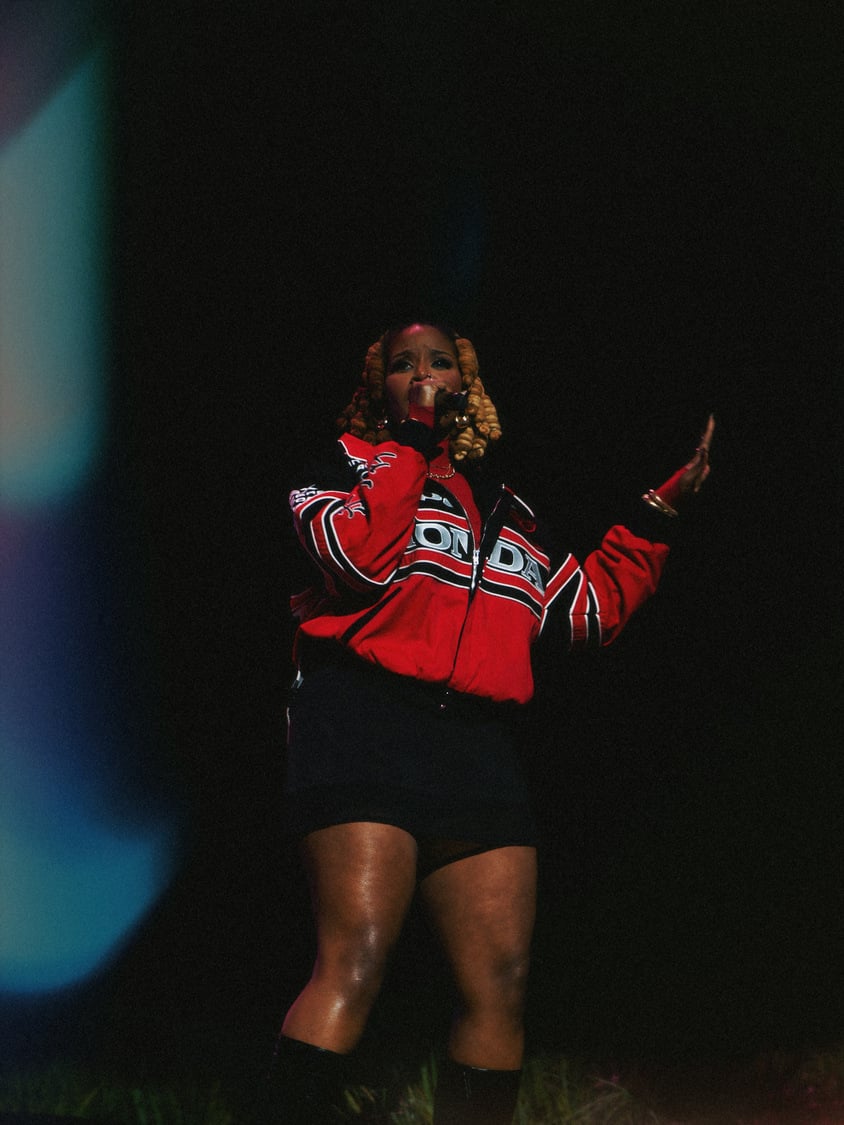
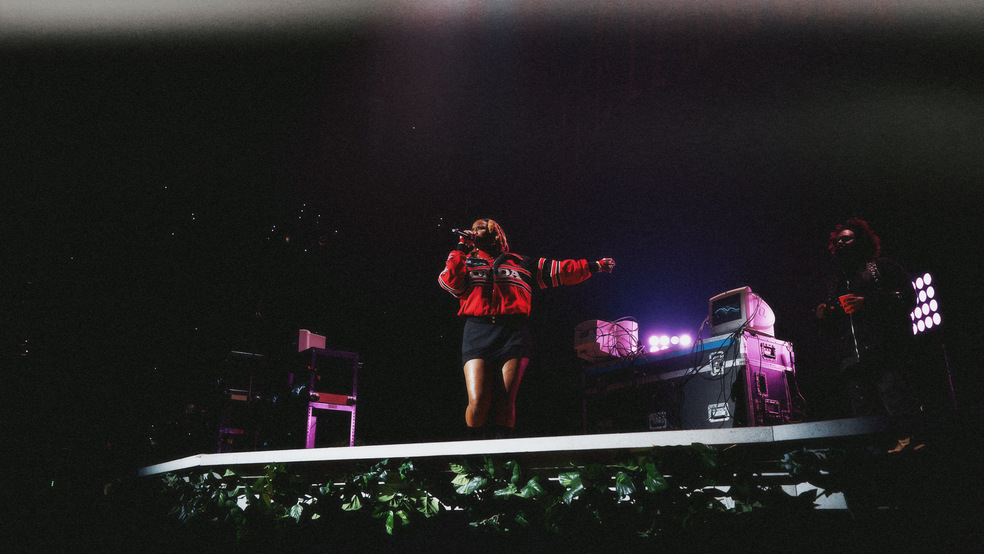
She’s a North Carolina native whose talented pen has contributed to some of the greatest acts within music. Throughout the years, she has gained recognition as a songwriter for Grammy-winning artists such as Usher and Chris Brown, yet, it’s her solo work that truly showcases the full range of her craft and artistry. Through her music, soulful storytelling is at the core of what she represents. At the root of her work are honesty, vulnerability, and authenticity. Her sound is akin to the deeply honest rawness of Mary J. Blige, and the poetic and melodic flow of Lauryn Hill. With a natural musical inclination, she has created a unique sonic world that draws from both R&B and Hip-Hop. Now, as singer/song-writer PJ joins “The Fall-Off Tour” alongside headliner and fellow North Carolinian, J. Cole—her voice, talent, and passion are reaching the masses. With great gratitude, I sat down to interview PJ and she gave Def Pen exclusive insight about her colorful journey that led her from behind the scenes to the spotlight, to now, opening for J. Cole across an arena world tour.
ZHAKIRA RAZHÉ: It’s so nice to meet you! So how have you been?
PJ: I have been good! I don’t know what day it is. I think we’ve been on tour for like 9 days at this point. So I’m definitely getting the swing of things. Trying to get my sleeping pattern together. But other than that, I’m doing good. How are you?
RAZHÉ: I’m doing great. I’m just happy to be here with you, so we can get into this! So, you’re currently on tour with J. Cole. What was your initial reaction when you knew you’d be opening for him across the arena tour?
PJ: I still feel like I’m reacting. I feel like every day I’m like, “Is this real? Is this my life?” You know? So, I think it’s still pretty crazy. I’m still, like, “Oh, it’s—a real thing.”
RAZHÉ: Yeah, absolutely!
PJ: I think every day, I’m still reacting to the fact that, you know, it’s frequently unbelievable.
RAZHÉ: So, what led to your collaboration with J. Cole on his “The Fall-Off” album?
PJ: There’s a studio in Atlanta— it’s legendary and been around for years. Its had everybody from Babyface, to Outcast. It’s called Tree Sounds. And about two years ago Omen had hit me up to work on his project, and he invited me. And, this whole time, I’ve always been aware of J. Cole, because I’m from Greensboro, North Carolina, which is not far from Fayetteville.
RAZHÉ: That’s right.
PJ: This was my first time working with Omen and that camp in general. I was the only girl there, and it was just like a bunch of producers, because they’re all, trying to make music for “The Fall-Off.” So there’s a lot of rooms going. Different artists were there. Like Leon Thomas was there, and Ab-Soul was there.
RAZHÉ: Oh wow, amazing.
PJ: I was in a room with Ab-Soul at the time, working out an idea and he (J. Cole) came into the room. He heard my voice and he was like “Who do you know here?” That’s when he found out I was from Greensboro. And on the last day of the camp, I was like “Yo, can I play some of my music?” and he really fucked with it. That’s how the relationship started. And he asked me to work on some stuff for the project. So he played this song he already had (“Legacy”), and I didn’t know what to add, but then I played it for him and he kept it on there. Thank God. And now, I’m on the album and on the tour.
RAZHÉ: I mean, that’s an amazing room to be in, because those are some of the best writers we have in our generation—including yourself. A lot of people will be knowing.
PJ: Yeah, they’ll find out.
RAZHÉ: You’ve been somebody who has worked with a lot of big names behind the scenes. What was that pivotal moment for you when you realized “Okay, I want to be the one in the spotlight.”
PJ: It wasn’t a glamorous realization. When I was younger, I always wanted to be a singer, but I was very shy I had really bad stage fright. Before I go on stage, currently, it’s a fight or flight thing, where I have to literally calm myself down because the anxiety that I get right before a show is crazy, you know?
RAZHÉ: Mhmm, yes.
PJ: When I got signed as a writer, I was always working on my sound in general. But in the music business—and I’ve heard Muni Long talk about this, it’s very hard to be taken seriously as an artist once the industry brands you as a writer. Victoria Monét has spoken on this too. And I consider them to be my peers.
RAZHÉ: Yeah, those are great examples of that situation.
PJ: Yeah, so it’s a journey— doing your artist stuff and it’s like, you just want the same level of respect. One thing that was different about me and Cole, he was one of the few people that when I would just play my music, he just got it. He just understood it.
RAZHÉ: That’s amazing. So then, knowing that you always wanted to be a singer, what was it when you were younger that led you down that path?
PJ: I think it was seeing “Showtime at The Apollo.” It was seeing people like Brandy and Monica perform. I feel like there were so many outlets to see your favorite artists perform.
RAZHÉ: Yes!
PJ: I remember, some nights, when I was a little kid, I was really short. I was short enough to stand on the bottom of the vacuum cleaner and then treat it like it was a mic stand.
RAZHÉ: Wow, that’s a powerful form of visualization right there. From a young age even. Growing up, it sounds like you had a lot of influences. When it comes to creating at your best, who are some of your influences that you look to?
PJ: I definitely love Whitney Houston, and I love Lauryn Hill, and I love Mary J. Blige. I love Mary J. Blige and Lauryn Hill because I feel like they had so much, umph, it’s like an in your face thing that I really pull from because it’s very close to Hip-Hop.
RAZHÉ: Yes, I love that!
PJ: Oh, and Missy! I like the girl’s going toe-to-toe with the dudes.
RAZHÉ: But it’s also that versatility, where they could do both if they wanted.
PJ: Yeah, because if I wanted to Rap, I could.
RAZHÉ: Yeah, and I can see that for sure.
PJ: Yeah, I prefer singing because I like all the things, like the harmonies and stuff. But that was something that even Common would tell me. When you hear the pockets that I sit in, you can tell that I listen to rap. And rap is very near and dear to my heart. “Late Registration” was a very big album to me. I always want the bigger than biggest production. I always liked how Kanye would bridge, Pop, Hip-Hop, and R&B in this like fusion type of thing. So I always strive to do that in most of my stuff.
RAZHÉ: What do you prioritize the most when you are creating music? Is it an idea? Is it a feeling?
PJ: I think it’s a feeling. I think it’s a melody. I think the athlete in me always wants to be the best that I possibly can.
RAZHÉ: I feel that! Recently, you released a single called “To The Ones”. What message were you wanting listeners to take away from it?
PJ: So, I finally cut off somebody that needed to be cut off. He was just somebody that was, very toxic. I feel like being a woman in the music business is like being a superhero. It’s like being Superman in a way.
RAZHÉ: Oh, yeahhh.
PJ: I feel it’s very disrespectful for a woman to work in a male dominated field, be an anomaly for real, be successful, and then meet a guy, and instead of them giving you a place of peace, I’m in such a stressful environment. You’re literally adding more stress. You’re either making me feel bad about myself, making me feel less secure. I’m like, how are you making it worse for me? So, you’re literally like kryptonite.
RAZHÉ: Mhmm, yup!
PJ: I have a vendetta against weak men of the world. Even with my music, I try my best, because I don’t like crying over men in my songs. I would rather promote strength and moving on in spite of. So with “To The Ones” there was a guy, his name is Marcus Johnson, which is the name of my project, “I Hate You Marcus Johnson.”
RAZHÉ: Wow, that is bold and I love it.
PJ: Yeah, I have a project dropping called “I Hate You Marcus Johnson,” which the next single, “2 Steps” that I’m about to drop is off of. And “To The Ones” opens up the whole thing—it took me two years to catch up to the actual theory of the song. It was just realizing, I’m really the one that got away and I should have never been dealing with you in the first place. We never should have been a thing.
RAZHÉ: Yeah, right.
PJ: A lot of things that I talk about in my music—women, most specifically black women —deal with. I would like to really bring up the conversation of low self-esteem is really what puts a lot of women in these tragic toxic situations because you don’t know that you deserve better.
RAZHÉ: Right.
PJ: I had to get to a place of healing. Even when I wrote this song, I was still checking his page. It was still just so mind boggling to me. But then, I heard that could be an ADHD thing, where it’s like, you always got to know “why?” Now, I understand. I wasn’t as confident as I am now. I didn’t really know my worth. There’s no way that this same man could pull me, this version of PJ, who she is now. You could never.
RAZHÉ: I feel like it always works out that way. You realize, “Dang, where was I in my mind?” [Laughs]
PJ: Yeah! At the bottom in the trenches.
RAZHÉ: Right. And even in that song, one of my favorite lines is, “I know why he ain’t save us. You would have had me chained up,” because, it’s really like that. There are certain situations if you do not leave, you will never elevate in life the way you’re supposed to. The way you’re meant to.
PJ: Exactly. Yes, he’s blocked. And it’s like, I know you see it. And that’s all the reward I need.
RAZHÉ: There we go.
PJ: Now I don’t care. I’m indifferent about it. You’re just not a factor. And I love the fact that he’ll never be able to get close to me again.
RAZHÉ: Ever. Not even the same realm of life.
PJ: Right. My goal now in life, other than being the best artist I possibly can, is to get so poppin’ that if you were to tell somebody that you used to fuck with me, they would never believe you.
RAZHÉ: One point you made earlier is that you would like to make music that is more strengthening than anything. And I did appreciate that. “To The Ones” wasn’t self-deprecating. At the end of it all, you kind of felt the release of just, “I’m here for myself and myself only.”
PJ: Yeah. Even with my other music, you’ll see, I have a lot of bouncy stuff and I play with a lot of tempo. So we’re gonna get through this slightly more emotional chapter, get everything off my chest, and then it’s like “Okay, I’m really that girl!” I had to bring some fun.
RAZHÉ: Yes!
PJ: I’ve had enough years of being told what to do, or letting people’s vision of me dictate who I want to be. So this new era, I’m just gonna be the best version of PJ. And I’m gonna go as hard as I possibly can for it. I’m enjoying that thoroughly. I don’t plan on being ditracted by another Marcus Johnson.
RAZHÉ: Right. You cannot afford it.
PJ: I can’t afford it.
RAZHÉ: No.
PJ: There were times where I was like, “Maybe I need to downsize my dream. Maybe arenas is not a thing.” And to be touring arenas, and then be on stage with J. Cole. —It’s like, no, you can still have all those things.
RAZHÉ: When people interact with your music, What do you hope that they take away
from it?
PJ: I want my music to be like the soundtrack to keep going. I would love for it to feel like a hug because I feel like that song that you play when the party’s over, when you feel a little bit alone. I would like to be that place for somebody. I would like to inspire that person to keep going.
RAZHÉ: Okay, I love that.
PJ: I feel like I’m the homegirl. My friend will always tell me, “You’re like a character off Insecure.”
RAZHÉ: Yeah, I can feel that! I also know you had a song on the soundtrack of Insecure.
PJ: I sure did.
RAZHÉ: Yes, full alignment right there.
PJ: Yeah, I’m a little awkward. I’m a little quirky.
RAZHÉ: Looking ahead, what can listeners expect as far as upcoming releases?
PJ: Prepare to be amazed. I’m shooting for the stars. I am an overthinker by nature, but it’s only because I want to put my best foot forward. And, prepare to get over that person. I think there is a familiarity that people will hear in my music when they listen. Is there any inspiration that you heard in general?
RAZHÉ: I remember when I was listening, I actually felt an influence of Mary J. Blige. So when you mentioned that earlier, I was like, wow, because that’s what I felt when I was listening for sure.
PJ: Yeah I love it. Yeah I feel good, because I’m glad that it translates.
RAZHÉ: When I listen, it’s that strength, it’s the vulnerability, it’s the honesty, but it’s also that “no bull***, don’t put me through it.”
PJ: I will literally drop a diss record on your a**. Please don’t play with me.
RAZHÉ: Now they know. PJ’s pen got hands.
PJ: Yes. I think with this album, I really want to go on a run. I really want to make good music back to back. I want it to be like “Dang, she got another one!” I feel like I can sit with the best of them




 ddd
ddd